
Detoxification isn't a single event — it is a continuous relay of transformation, neutralization, transport, and elimination.

If you have ever been told your bloodwork is normal and yet you still feel inflamed, foggy, hormonally off, sensitive to everything, or like your body cannot seem to keep up — there is a good chance no one has explained your detox pathways to you. Not really. Not in a way that connects the biochemistry to the bigger picture of how your body processes and eliminates what it no longer needs.
This is one of those topics that gets thrown around in wellness circles in a way that can feel either too vague — drink more water, sweat it out — or too intense — cleanse for ten days and rebuild your gut from scratch. Neither really captures what is happening inside the body when we talk about detoxification.
So let me walk you through it the way I walk clients through it in my office: in plain language, with respect for how smart and complex your body actually is.
Your body is not waiting for a cleanse to begin detoxifying. It is processing compounds every second of every day. The more useful question is whether the systems responsible for transforming, transporting, and eliminating those compounds have the resources they need to function well.
What Detoxification Actually Is
Detoxification is part of your body's normal biochemistry. It is how the body chemically processes substances it needs to modify, use, neutralize, transport, or eliminate — including hormones, medications, alcohol, environmental compounds, and byproducts of normal metabolism.
The liver is the organ most people associate with detoxification, and for good reason. But it is not working alone. The kidneys, gastrointestinal tract, lungs, bile system, microbiome, circulatory system, and cellular transport systems all participate in what ultimately happens to the compounds your body processes.
Think of detoxification less like a single organ "cleaning" the body and more like a coordinated relay. One enzyme modifies a compound. Another pathway attaches something to it. Transport proteins move it across a cell membrane. Then the kidneys, bile, intestines, or another route may help move it out of the body.
The commonly used detoxification model divides much of this chemistry into three phases:
- Phase I — Transformation
- Phase II — Conjugation
- Phase III — Transport
And then there is one final piece that matters enormously: elimination. Let's break it down.
Phase I — The Activation Phase
Phase I is the body's "we need to do something with this" step. Enzymes chemically modify compounds so they can be metabolized further. Sometimes that creates a more reactive intermediate, which is one reason the next steps matter so much.
Phase I is where the body begins chemically modifying many substances — including medications, hormones, environmental compounds, and other molecules.
This phase is run largely by a family of enzymes called cytochrome P450 enzymes, often shortened to CYP450. These enzymes perform reactions such as:
- Oxidation
- Reduction
- Hydrolysis
Your CYP enzymes can be influenced by genetics, medications, foods, environmental exposures, hormones, and many other factors.
Here is an important part of the process: some Phase I reactions create metabolites that are more chemically reactive than the original compound. That is not necessarily a mistake — it can be part of the normal processing pathway. But those reactive metabolites then need to be handled appropriately through antioxidant systems, Phase II conjugation, transport, or additional metabolism.
This is why Phase I cannot really be understood in isolation. It is one part of a much larger metabolic system.
What can influence Phase I?
A number of things can influence CYP450 enzyme activity, including:
- Genetic variants in CYP450 enzymes
- Certain medications
- Alcohol
- Smoking
- Hormonal signaling
- Foods and plant compounds
- Nutritional status
- Environmental exposures
- Inflammation and illness
This is one place where Functional Genomics Testing becomes interesting. Two people can be exposed to the same substance and metabolize it differently because the enzymes involved may work at different rates. But Phase I is only the beginning.
Phase II — The Neutralizing Phase
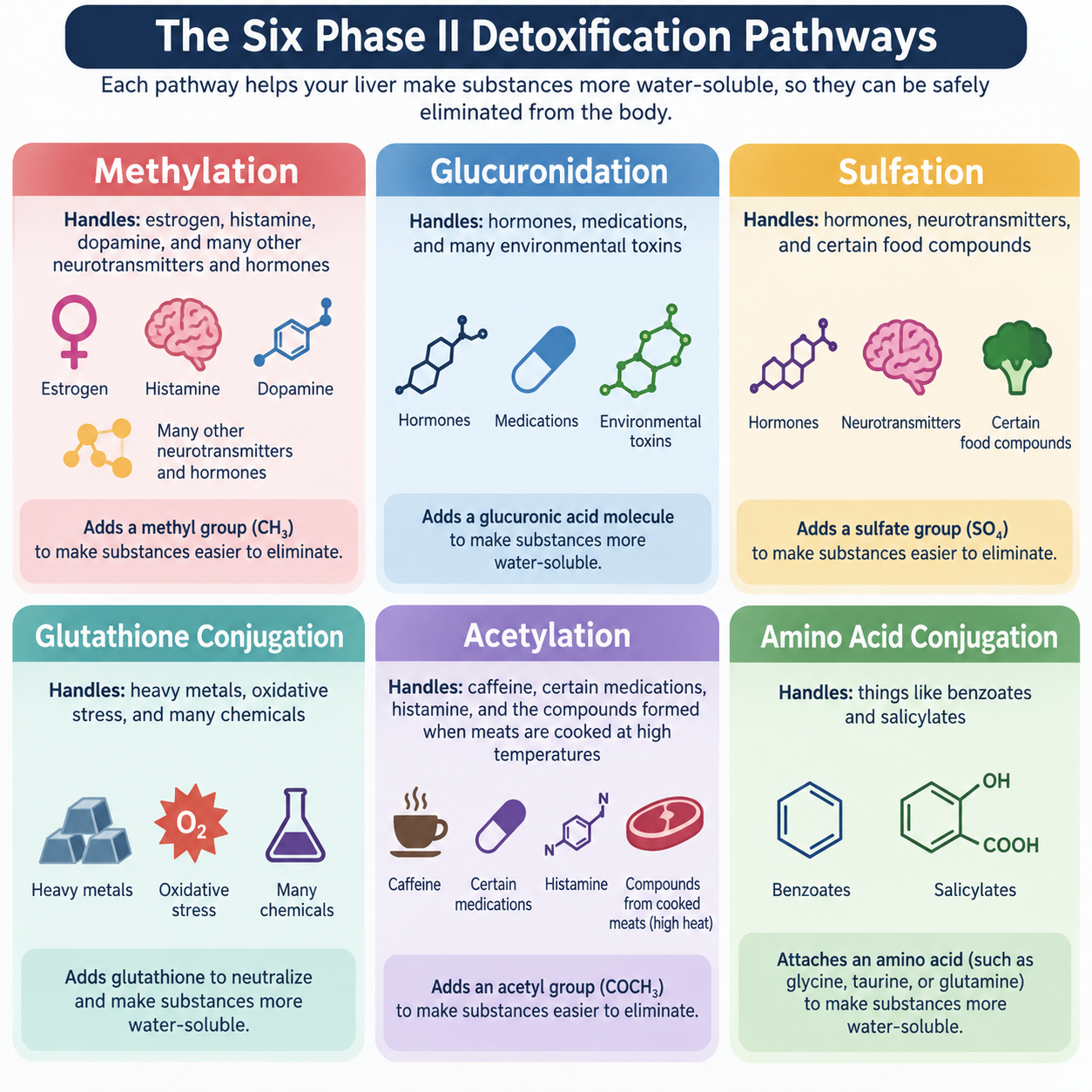
Phase II is the conjugation phase. The body attaches specific molecules to many compounds, changing their chemistry and often making them easier to transport or eliminate. You can think of it as adding a chemical "handle" that helps the body move a substance into its next step.
Phase II includes several major conjugation pathways.
Methylation
Methylation transfers a methyl group onto certain molecules. It is involved in the metabolism of compounds including:
- Catechol estrogens
- Histamine
- Catecholamines such as dopamine
- Many other endogenous molecules
Genes such as COMT and HNMT participate in specific methylation reactions.
Glucuronidation
Glucuronidation attaches glucuronic acid to compounds. It plays an important role in processing:
- Hormones
- Bilirubin
- Many medications
- Environmental compounds
- Numerous metabolic byproducts
This pathway is driven largely by UGT enzymes.
Sulfation
Sulfation attaches sulfate groups to compounds. It contributes to the metabolism of:
- Hormones
- Neurotransmitters
- Medications
- Phenolic compounds
- Numerous dietary and environmental molecules
This pathway depends on enzymes called sulfotransferases, or SULT enzymes.
Glutathione Conjugation
Glutathione can bind to certain reactive and electrophilic compounds, helping reduce their reactivity and supporting further processing and elimination. Glutathione-S-transferase enzymes — the GST family — play an important role here. Glutathione also serves another major function in the body: antioxidant defense.
Acetylation
Acetylation uses enzymes including the NAT family to modify certain compounds and medications. NAT2 genetics are especially well known because people can have different acetylator phenotypes — often described as slow, intermediate, or rapid acetylators.
Amino Acid Conjugation
The body can also conjugate certain compounds with amino acids such as:
- Glycine
- Taurine
- Glutamine
This pathway helps process several organic acids and other metabolic compounds.
Why Phase II Is So Individual
Each of these pathways uses different enzymes. Each relies on different substrates and cofactors. And each can be influenced by genetics, nutrition, medications, health status, and exposure.
That means two people can process the same substance differently. One person may have genetic variants affecting methylation enzymes. Another may have differences in glucuronidation. Someone else may carry GST variants that influence glutathione conjugation.
This is one of the places where Functional Genomics Testing can give us useful context. A genetic variant does not tell us that a pathway is "broken." And it does not diagnose a detoxification problem. What it can do is show us where an individual may have biochemical differences worth considering alongside symptoms, history, exposures, diet, medications, and laboratory information.
Genes do not decide your destiny. But they can help explain why two people following the same protocol may respond very differently.
Phase III — The Transport Phase
Phase III is not simply "going to the bathroom." Phase III is primarily about transport. After the body has transformed or conjugated compounds, specialized proteins help move those compounds across cell membranes and toward the places they need to go next.
Think of Phase III as the shipping department. Phase I modified the package. Phase II prepared and labeled it. Phase III helps move it out of the cell and toward the appropriate destination.
Meet the transporters
Phase III relies heavily on specialized membrane transport proteins. Two major transporter families you will see in this conversation are:
- ABC transporters — ATP-binding cassette transporters
- SLC transporters — solute carrier transporters
These transporter families help move an enormous variety of substances across cell membranes. Depending on the transporter and the tissue, they may move:
- Medications
- Metabolic byproducts
- Hormones and hormone metabolites
- Bile acids
- Conjugated compounds
- Environmental chemicals
- Nutrients
- Other molecules the body needs to move between compartments
The liver, intestines, kidneys, and other tissues contain many of these transport proteins.
The genes behind Phase III
Because these transporters are proteins, they are built from genes — and those genes can carry common variations from one person to the next. The ABCC family is a good example. These genes code for a group of ABC transporters sometimes called multidrug resistance-associated proteins, or MRPs. One that comes up often in Phase III is ABCC2 (also known as MRP2), which helps move certain conjugated compounds out of liver cells and into bile.
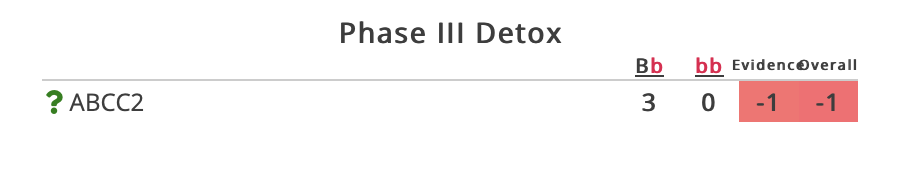
A result like this does not mean a pathway is "broken." It simply flags where your transport genes may carry variations worth considering alongside your symptoms, history, medications, and the rest of your detox picture. That is exactly the kind of detail Functional Genomics Testing is designed to surface.
This is an important distinction: Phase III is the transport step. The actual removal of a substance from the body happens through the body's elimination routes. And those elimination routes are what many wellness conversations have traditionally lumped into "Phase III." They are connected — but they are not exactly the same thing.
So Where Do Bile and Bowel Movements Fit?
Right here. They still matter enormously. They simply belong under the broader category of elimination, rather than being the definition of Phase III itself.
After a compound has been processed and transported, it may eventually leave the body through several routes. Two of the biggest are:
Bile and stool
The liver can transport certain compounds and conjugated metabolites into bile. Bile then travels into the intestinal tract. Some of those compounds ultimately leave the body in stool.
Kidneys and urine
Other compounds enter the bloodstream and are filtered or secreted by the kidneys before leaving through urine.
This means healthy elimination is still an important part of the overall detoxification picture. You can have perfectly functional metabolic enzymes, but the body still needs appropriate transport and excretion systems to finish the job.
Why the Gut Still Matters
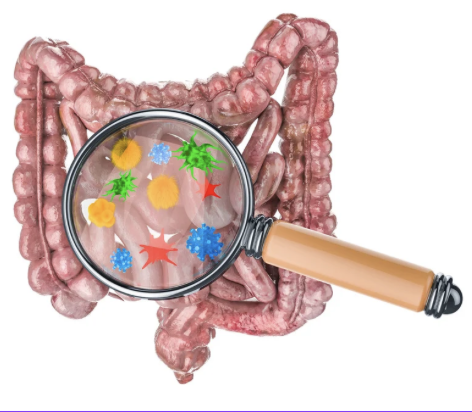
One of the fascinating things about biliary elimination is that sending something into the intestine does not always mean the story is over. Some compounds can be modified by intestinal bacteria and then reabsorbed. This is part of what is called enterohepatic circulation.
One example involves an enzyme made by certain gut bacteria called beta-glucuronidase. Remember glucuronidation from Phase II? The liver can attach glucuronic acid to certain compounds. After those glucuronidated compounds enter the intestine through bile, bacterial beta-glucuronidase can sometimes remove that glucuronic acid. That may allow some compounds to become available for reabsorption.
This is one reason the gut microbiome and intestinal transit matter when we talk about elimination.
And yes — bowel movements matter
Regular bowel movements help move material through the gastrointestinal tract and ultimately out of the body. But I want to make an important distinction here. You do not have to have a bowel movement every single day to be considered medically normal. Healthy bowel frequency varies significantly between people.
What matters is the bigger picture:
- Is stool passing comfortably?
- Are you straining?
- Do you feel completely evacuated?
- Are stools consistently very hard?
- Has your bowel frequency changed?
- Are you bloated or uncomfortable?
- Is intestinal transit unusually slow?
Someone having a bowel movement every two or three days may still fall within the broad population range considered normal. At the same time, frequency alone does not tell us everything about bowel function. Comfort, stool consistency, transit time, and symptoms matter too.
Where Does the Lymphatic System Fit?
The lymphatic system absolutely matters to whole-body physiology. But I would not technically call lymphatic drainage "Phase III detoxification." The lymphatic system helps:
- Return interstitial fluid to circulation
- Transport immune cells
- Move proteins and other molecules out of tissues
- Absorb and transport dietary fats from the intestine
- Maintain normal fluid balance
That makes lymphatic function highly relevant to tissue health and fluid movement. But the classic biochemical definition of Phase III refers more specifically to cellular membrane transporters.
I would go so far as to say a healthy lymphatic system is one of the hallmarks of longevity and healthy aging.
— Helen Parde, LMT
The body uses multiple transportation systems at different scales:
- Transporters move molecules across cell membranes.
- Blood moves compounds between organs.
- Lymph moves fluid and molecules out of tissues and back toward circulation.
- Bile carries compounds into the intestine.
- The kidneys filter and secrete compounds into urine.
- The gut moves material toward stool.
They are all part of the larger movement-and-elimination story.
Why the Three Phases Have To Talk To Each Other
The three phases are not isolated departments. They overlap. A compound may go through Phase I and Phase II. Another compound may undergo Phase II without Phase I first. Transporters can move parent compounds as well as Phase I and Phase II metabolites. Some substances can move back and forth between tissues before eventually being eliminated.
So instead of imagining detoxification as a perfectly straight assembly line, think of it as a network:
- Transformation
- Conjugation
- Transport
- Circulation
- Excretion
- Reabsorption in some cases
- Then further metabolism or elimination
The body is continuously coordinating all of it.
A Few Patterns Worth Understanding
These are not diagnoses. They are simplified ways of understanding how differences in metabolism, transport, gut function, and elimination might influence the way different people respond.
Pattern 1 — Faster Phase I Activity With Limited Downstream Capacity
Some people appear to process certain substances rapidly through specific Phase I enzymes while having less capacity in the pathways needed to handle the resulting metabolites. Depending on the compound involved, this could influence how someone responds to:
- Medications
- Alcohol
- Caffeine
- Hormones
- Environmental chemicals
But a symptom by itself does not tell us which enzyme or pathway is responsible. This is where history, genetics, medication interactions, nutrition, and other clinical information become important.
Pattern 2 — Differences in Estrogen Metabolism
Estrogen metabolism is much more complex than simply "high estrogen" or "low estrogen." Some estrogens are first hydroxylated through CYP enzymes. Certain catechol estrogen metabolites can then be methylated by COMT. Other estrogen metabolites undergo:
- Glucuronidation
- Sulfation
- Further metabolism
- Transport
- Biliary or urinary elimination
This means genetics affecting enzymes such as CYPs, COMT, UGTs, SULTs, and transport proteins may influence different parts of estrogen metabolism. Gut bacteria may also influence the reactivation and reabsorption of some estrogen metabolites through enterohepatic circulation.
That does not mean every case of PMS, heavy periods, breast tenderness, fibroids, or perimenopausal symptoms is a "detox problem." But estrogen metabolism and elimination are absolutely part of the larger hormonal picture.
Pattern 3 — Normal Processing With Slower Elimination
This is the pattern I think gets misunderstood when we casually call bowel function "Phase III." A person may have functioning Phase I and Phase II enzymes and functioning Phase III transporters, but still have issues farther downstream. For example:
- Constipation
- Slow intestinal transit
- Changes in bile flow
- Kidney dysfunction
- Altered microbiome activity
- Changes in enterohepatic circulation
Those are elimination issues, not necessarily Phase III transporter defects. But they can still influence what ultimately happens to compounds the liver has processed.
Processing something is not the same as getting it completely out of the body.
Pattern 4 — The Nervous System Layer
The nervous system belongs in this conversation too. But I would describe it more accurately than simply saying "detoxification is a parasympathetic process." Your autonomic nervous system influences:
- Digestion
- Gastrointestinal motility
- Blood flow
- Bile and pancreatic function
- Immune signaling
- Metabolism
- Stress hormones
Long-term stress can change many of these systems. That does not mean Phase I, Phase II, and Phase III simply shut down every time you are stressed — the relationship is much more nuanced. But chronic nervous system dysregulation can absolutely change the physiological environment in which digestion, metabolism, and elimination are taking place.
That is why nervous system support can still be an important part of a whole-body wellness approach — without needing to call detoxification itself a parasympathetic process.
What Actually Helps — The Whole-Body View
This is the part where most wellness articles tell you to drink lemon water and call it a day. We can go much deeper than that.
1. Understand your individual genetic blueprint
Functional Genomics Testing can identify genetic variants in enzymes and transporters involved in:
- Phase I metabolism
- Methylation
- Glucuronidation
- Sulfation
- Glutathione pathways
- Acetylation
- Antioxidant defense
- Cellular transport
That does not tell us with certainty how fast an entire detoxification pathway is functioning. Genes are one layer of the picture. But they can help us understand biochemical tendencies and ask better questions.
2. Support the nervous system
The nervous system affects digestion, gut motility, circulation, sleep, immune activity, hormonal signaling, and many other systems involved in whole-body health. That makes nervous system regulation foundational — not because relaxation magically "turns detox on," but because the autonomic nervous system communicates with many of the organs involved in metabolism and elimination.
3. Support healthy movement and elimination
This is where I would separate Phase III transport from the body's broader drainage and elimination systems. Healthy physiology requires movement at multiple levels:
- Cells need functioning transport proteins.
- The liver needs appropriate bile transport.
- The kidneys need to filter and secrete compounds.
- The gut needs effective motility.
- The circulatory and lymphatic systems need to move fluids appropriately.
This is also where bodywork can support the bigger wellness picture. Lymphatic work, massage, myofascial techniques, movement, and foot zone therapy should not be described as "performing Phase III detox." But they can be used as part of a broader approach to:
- Movement
- Relaxation
- Tissue mobility
- Circulation
- Lymphatic fluid movement
- Nervous system regulation
- General well-being
That distinction matters. We do not need to overstate what bodywork does in order for bodywork to be valuable.
4. Feed the pathways
The enzymes involved in metabolism require nutrients. Depending on the pathway, nutritional factors may include:
- B vitamins
- Magnesium
- Amino acids
- Sulfur-containing compounds
- Antioxidants
- Glutathione precursors
- Protein
- Fiber
- Adequate hydration
More is not always better. The goal is not to "push detox." It is to give normal physiology the raw materials it needs.
5. Support the gut
The intestinal tract is part of the elimination pathway, and the microbiome can influence whether certain compounds remain conjugated or become available for reabsorption. Supporting gut health may include attention to:
- Fiber
- Hydration
- Bowel regularity
- Microbial diversity
- Stool consistency
- Digestive function
- Individual food tolerance
Again, the goal is not necessarily a bowel movement at an exact prescribed frequency. The goal is healthy, comfortable, effective gastrointestinal function.
6. Reduce the inputs you can
This is not about trying to create a toxin-free life. That is impossible. It is about reducing unnecessary exposure where it makes sense. Your body already has sophisticated systems for handling the chemistry of everyday life — supporting those systems can include simply giving them less unnecessary work to do.
If You Are Reading This and Something Is Clicking
If you have spent years being told your labs look fine while still feeling like something is off, metabolism and elimination may be one piece worth looking at. Not the whole answer. And not every symptom is a detoxification problem. But understanding these pathways gives us another way to look at how genetics, nutrition, gut function, hormones, medications, exposures, and nervous system health interact.
Your body is incredibly intelligent. It is transforming molecules, transporting nutrients, recycling compounds, balancing fluids, metabolizing hormones, filtering blood, and eliminating waste every second of every day.
The work is not to force it into some dramatic "detox." The work is to understand the systems already doing that job and ask where appropriate support might help.
That is the work I do at Whole Body & Sole. Nervous system regulation, Functional Genomics Testing, bodywork, lymphatic work, and foot zone therapy all approach the body from different angles. The goal is not to claim that every symptom comes from a blocked detox pathway. It is to look at the bigger picture and ask: what does this individual body need in order to function as well as it can?
If this resonates, a discovery call is a good place to start. No pressure. No one-size-fits-all protocol. Just a conversation about what your body has been experiencing and which pieces may be worth exploring.