Please read: This post is for education only. It is not medical advice and is not meant to diagnose or treat any condition. Talk with your healthcare provider about symptoms, testing, and treatment.
Affiliate disclosure: I'm a Fullscript practitioner. If you order through my dispensary, I may earn a small commission at no extra cost to you.
You eat well. You take your supplements. And you still wonder: is any of this actually working?
Maybe you've even had your genes tested and you know you carry an MTHFR variant. That's the question the NutrEval test was built to answer. Your genes show what your body is prone to. The NutrEval shows what your body needs right now. Together, they offer a picture of your health you really can't get anywhere else, and that becomes super valuable for your ongoing health decisions.
Your genes are the map. The NutrEval is the weather report.
Functional Genomics Testing reads more than 90,000 markers from one cheek swab. It shows how you're wired to handle folate, detox, oxidative stress, histamine, hormones, and more. Your genes don't change, so you only test once.
What does change is what your body has on hand today. Food, stress, gut health, medications, and your season of life all shift it. A gene variant shows where a bottleneck could be. The NutrEval shows whether that bottleneck is actually showing up right now.
Take MTHFR. Certain variants slow how well your body activates folate, according to the NIH Office of Dietary Supplements. The gene tells us to pay attention. The NutrEval's methylation and B-vitamin markers tell us whether your body is asking for more support today, or whether you're already covered.
Takeaway: Genes tell us where to look. The NutrEval tells us what's happening there now.
What the NutrEval test measures
The NutrEval comes from Genova Diagnostics. It uses blood and urine to look at more than 125 biomarkers and estimate your body's functional need for 40 nutrients: antioxidants, vitamins, minerals, essential fatty acids, amino acids, and digestive support.
| Area | What it looks at | Why it matters |
|---|---|---|
| Organic acids | Byproducts of energy production, B-vitamin markers, neurotransmitter breakdown, detox markers, gut bacteria and yeast byproducts, oxalates | Shows how well your metabolism is running, step by step |
| Oxidative stress | Cell and DNA damage markers alongside antioxidant levels | Shows whether your defenses are keeping up |
| Amino acids | Essential and nonessential amino acids | Protein digestion, repair, and the raw materials for mood chemicals |
| Fatty acids | Omega-3, 6, and 9 balance in red blood cells, plus the Omega-3 Index | Reflects roughly the last 90–120 days, not just last week |
| Elements | Copper, zinc, magnesium, potassium, manganese, selenium; lead, mercury, arsenic, cadmium | Minerals you need and metals you don't |
The report scores five "functional pillars": methylation, toxic exposure, mitochondrial function, fatty acid balance, and oxidative stress. It then suggests nutrient amounts based on your own results (Rupa Health, updated 2025).
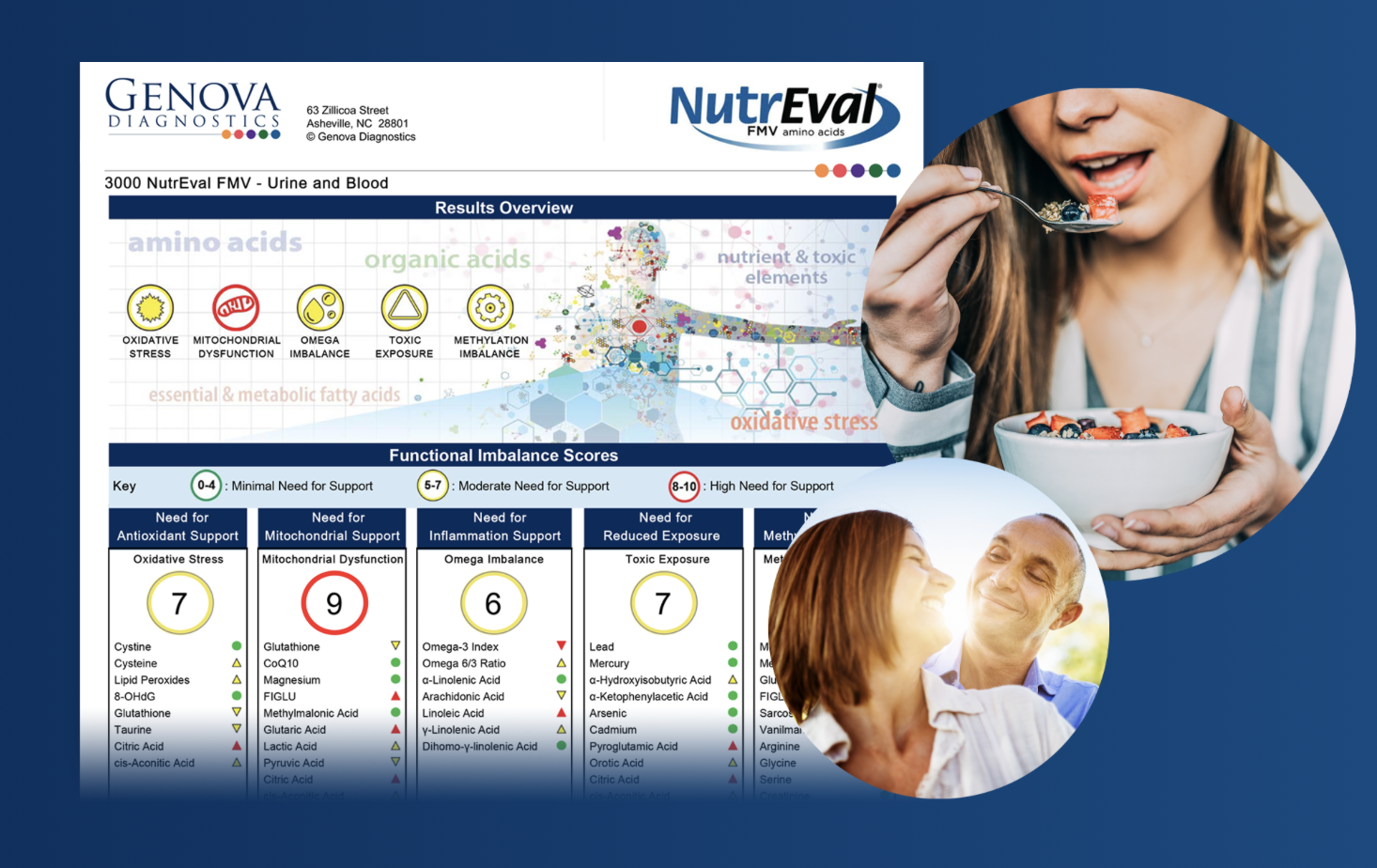
Providers can also add vitamin D and four genetic markers: MTHFR, COMT, TNF-alpha, and APOE. Functional Genomics Testing already reads those, and thousands more.
Takeaway: One test, five areas of your body's chemistry, and a nutrient plan built from your numbers.
"Deficient" and "insufficient" aren't the same thing
A 2017 analysis of U.S. national survey data found that 31% of Americans were at risk of at least one vitamin deficiency or anemia. That's deficiency: the point where problems start to show up.
Insufficiency comes earlier. You have enough to avoid illness, but not enough to run well. Standard labs are built to catch deficiency. The NutrEval looks for insufficiency too.
It does this with functional markers. When a B vitamin runs low, the enzyme that needs it slows down, and certain organic acids build up in your urine. That's your body showing a need, not just a level.
Takeaway: "Normal" can still mean "not enough for you."
Better together: NutrEval + Functional Genomics Testing
You can add a NutrEval to my Functional Genomics Testing package. The package already includes integration of your labs, and the NutrEval is one of the most useful labs to add because so many of its markers line up with your genes:
- Detox genes (glutathione, Phase II pathways) pair with oxidative stress and toxic element markers. More in Detox Pathways Explained.
- Oxalate genes pair with oxalate markers. See oxalates in "superfoods".
- Neurotransmitter genes like COMT pair with dopamine and adrenaline breakdown products.
- Nutrient transport genes (up to 67 variants) pair with your actual mineral levels. Related: humic and fulvic acid minerals.
Your genes are read once, for life. A NutrEval can be repeated, usually after 3–4 months, to see whether your plan is working.
Takeaway: Genes explain the why. The NutrEval shows the now, and later shows the progress.
What taking the test is like
- The day before: Eat your usual diet. Keep fluids under about 48 ounces in the 24 hours before so your urine isn't diluted.
- Collection morning: Fast overnight (water is fine). Collect your first-morning urine at home, then get a fasting blood draw.
- Supplements: Whether to pause depends on the goal. Do we want a baseline, or a check on your current plan? We decide together.
- Results: About 14 days, per Genova.
- Good to know: Not available in New York state, and not for children under 2.
- No blood draw? Genova's Metabolomix+ is a similar profile collected entirely at home.
Where it fits, and where it doesn't
It works alongside standard blood work. Thyroid, iron, B12, vitamin D, and blood sugar are often covered by insurance. Specialty labs like the NutrEval usually aren't. If you're tracking hormones too, my DUTCH test post covers that side.
It doesn't diagnose. It shows patterns that guide food, lifestyle, and supplement choices.
My role is clear. I don't diagnose or prescribe. When a result needs medical follow-up, I'll send you back to your doctor with better questions.
You don't have to guess
If you've been buying supplements on hunches, you're not doing it wrong. You just haven't had the full picture.
Your genes show the map. The NutrEval shows where you are on it today.
Curious which test, or which combination, fits you? Book a free Discovery Call and we'll talk it through. No pressure.
Frequently asked questions
Is the NutrEval a genetic test?
Mostly no. It measures your current nutrient status in blood and urine. It offers four optional genetic markers. Functional Genomics Testing reads more than 90,000.
Do I need both?
Not always. Genomics shows lifelong tendencies; the NutrEval shows current needs. Together they give the clearest plan, which is why I offer the NutrEval as an add-on to my Functional Genomics package.
What does a NutrEval report look like?
You can view Genova's NutrEval FMV sample report. It's detailed, so we go through yours together and connect it to your genetics.
Which should I do first?
Many clients start with Functional Genomics Testing because it's one test for life and shows which NutrEval markers matter most for you. Either order works.
What's the difference between NutrEval FMV and NutrEval Plasma?
Only how amino acids are measured: urine (FMV) or blood (Plasma). Both need a blood draw and a first-morning urine sample.
Affiliate disclosure: I'm a Fullscript practitioner and may earn a small commission on orders through my dispensary, at no extra cost to you.
This article is for education and isn't medical advice. Please talk with your healthcare provider about symptoms, testing, and treatment.
Written by Helen Parde, LMT, CFNC, owner of Whole Body and Sole in Herriman & South Jordan, Utah. Helen is a Certified Functional Genetics Analyst and nervous system health coach who reads every genomics report herself, alongside your symptoms, history, and labs.