
My hands are how I work.
Every massage, every Foot Zone session, every craniosacral hold runs through them. After nearly 20 years of bodywork, I've learned that the hands that care for everyone else need care too. Red light therapy for hands has become one of my favorite ways to give mine some of that care back, and the AO Glove by Solex is how I do it.
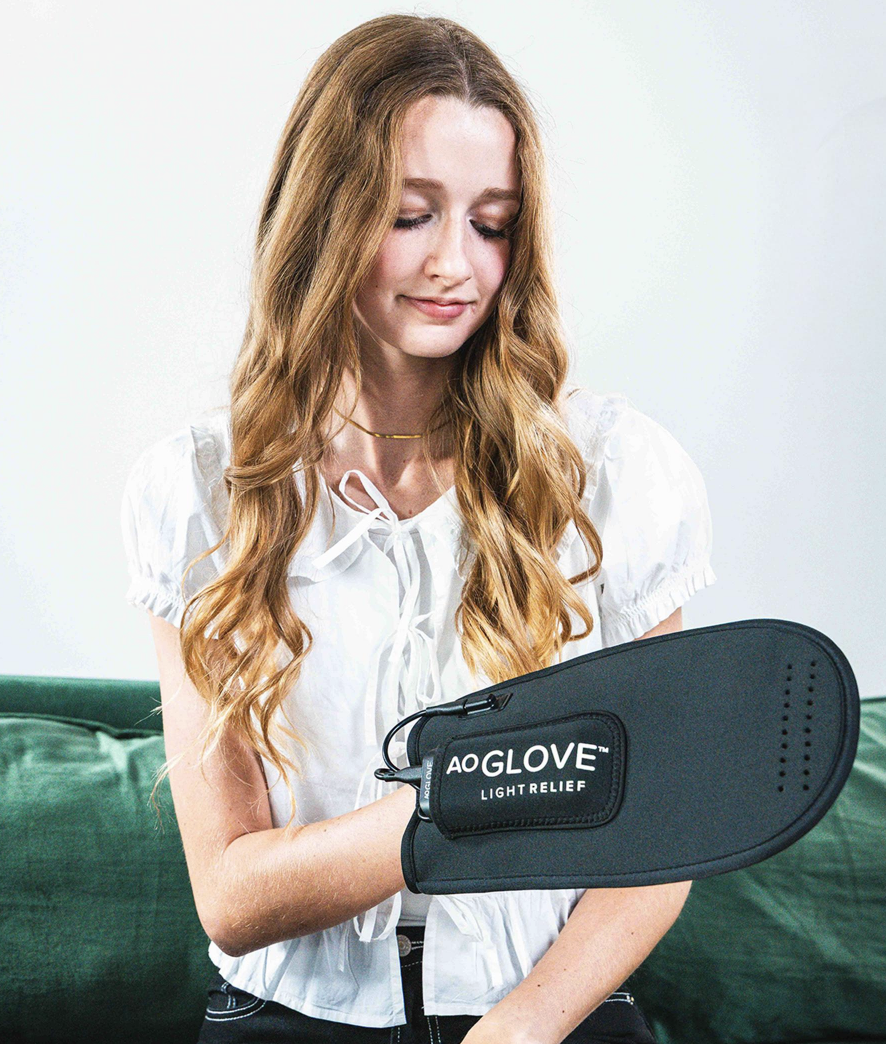
A massage therapist's hands take a beating
People see the relaxing side of massage. What they don't see is the work behind it: thumbs pressing into tight shoulders, fingers working through knots, wrists bent at angles they were never designed to hold all day. By the end of a full day, my hands feel it. They ache, they stiffen, and sometimes my thumbs just feel tired.
I'm not alone. A survey of 502 registered massage therapists across Canada found high rates of pain in the wrists, thumbs, and the rest of the upper body. That was true even though most of them said they had been trained in good body mechanics and self-care (Albert et al., Journal of Bodywork and Movement Therapies, 2008). Good technique helps. It doesn't erase the wear and tear of doing hands-on work for years.
You don't have to be a massage therapist for this to sound familiar. Hairstylists, nurses, gardeners, moms, keyboard workers, and anyone who grips, types, or lifts all day can feel it too.
How I use the AO Glove on both hands
I don't treat just one hand. I slip a glove on each hand so both get light at the same time. My hands work as a team all day, so they recover as a team too.
- After my last clientHands washed and dried, rings off.
- Both gloves onThe fit is loose and relaxed. They don't squeeze, so my hands can fully let go.
- Sit back and breatheHands resting open on my lap, a few slow breaths. A small signal to my nervous system that the workday is done.
- NoticeWhen I take them off, my hands feel warmer, softer, and more ready to move.
Some days I use them in the morning too, before my first session. Solex suggests no more than three sessions per day per hand, and that's plenty.
What's inside the AO Glove
The AO Glove is a soft, hands-free mitt that wraps your hand, fingers, and wrist in light. It uses the same five wavelengths as the rest of the AO Light family.
Supports clear, calm skin on the surface of your hands.
Being explored for its role in calming the nervous system and how we perceive discomfort.
Supports local circulation and healthy connective tissue.
Reaches deeper layers for muscle and joint comfort.
The deepest reach, toward the joints and tendons of the fingers and wrist.
These statements have not been evaluated by the Food and Drug Administration. Product details: Solex AO Glove.
It's rechargeable, and the controls are simple. If you've used the AO Foot, it will feel familiar. It's the same technology, shaped for your hands.
Watch: the AO Light devices I use
The glove is just one piece of my light routine. In this video, I walk through each of the red light devices I use and what I reach for each one for.
Meridians: why hands and feet are such powerful places
Here's the part I love most. In Traditional Chinese Medicine, energy (qi) is said to flow through pathways called meridians. There are 12 main meridians, and every one of them begins or ends in the hands or the feet. That's why each one carries "hand" or "foot" in its traditional name (Lee, Ryu & Chae, Integrative Medicine Research, 2023).
6 through the hands & arms
Lung, Large Intestine, Heart, Small Intestine, Pericardium, and Triple Burner (San Jiao).
6 through the feet & legs
Spleen, Stomach, Kidney, Bladder, Liver, and Gallbladder.
The tips of the fingers and toes are where these channels meet and hand off to each other. In this tradition, they're treated as some of the most active points on the body.
As a Foot Zone practitioner, this is home turf for me. I've spent years watching how much the feet reflect what's happening in the whole body. The hands carry that same kind of map. So when I wrap both hands in light, I'm not only caring for tired muscles and joints. In the traditional view, I'm also bathing the starting and ending points of six meridians at once.
Curious about your body's energetic pathways?
In an AO Vitals Scan, we look at your meridians and so much more. The scan shows each meridian's energy as high, normal, or low, along with your chakras, so we can compare your current reading with your last one and see what's shifting.
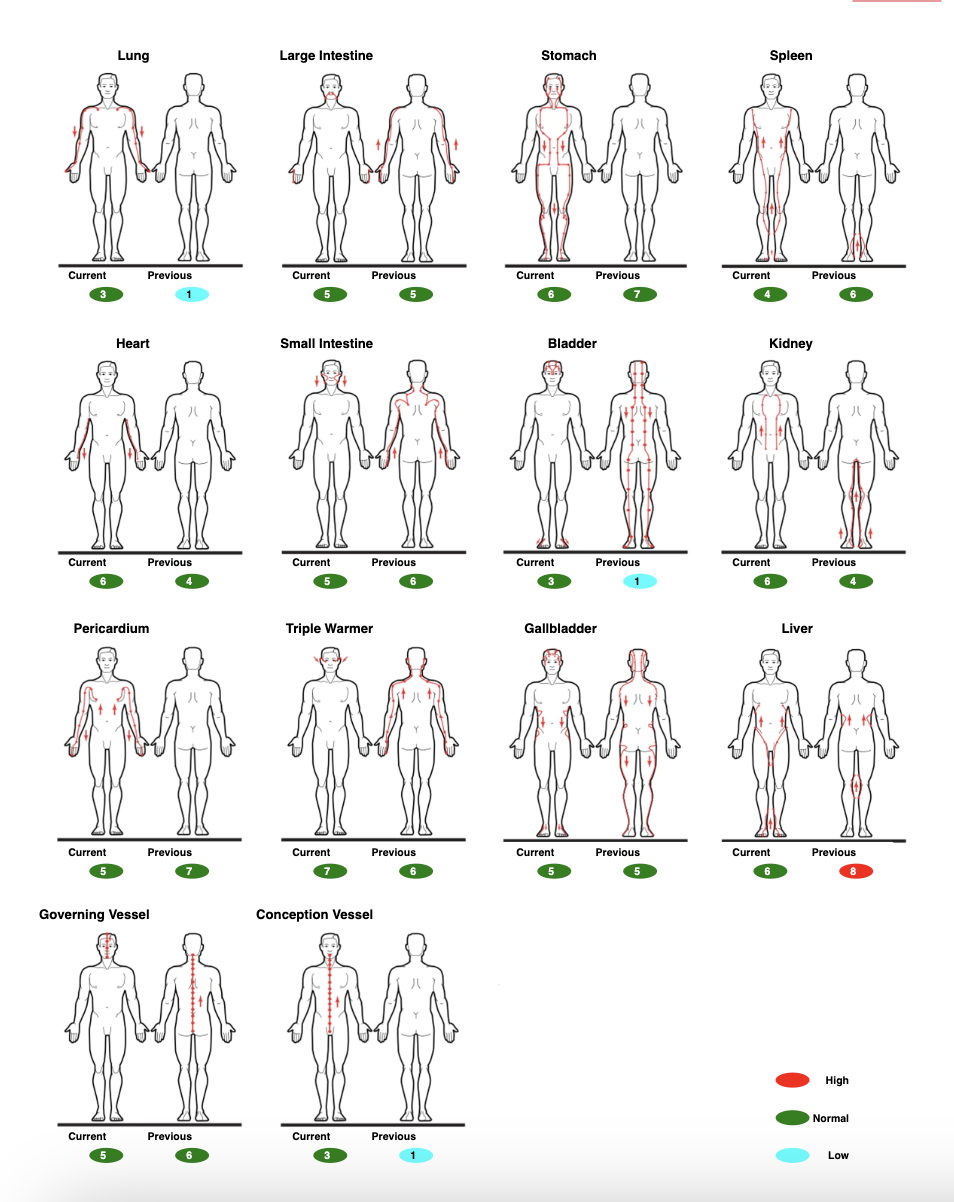
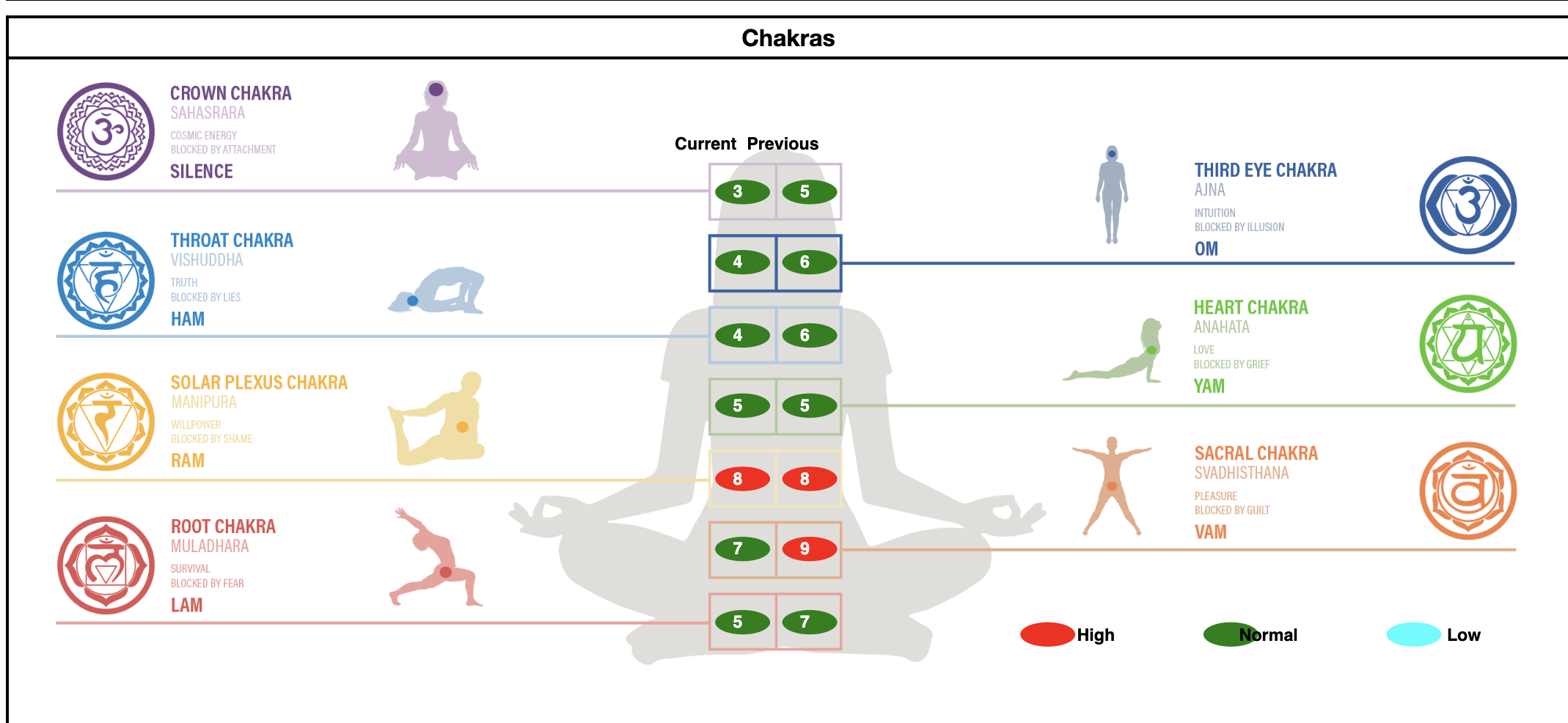
Your Vitals Scan is part of a 1:1, 90-minute health coaching session with me, where we walk through your results together and build your next steps.
Book a Vitals Scan SessionAO Scan is a wellness and biofeedback tool. It is not a medical device and does not diagnose disease. Tap an image to see it full size.
Light for the skin on your hands
It's not only joints and tendons. The skin on a massage therapist's hands goes through a lot too: oils, lotions, essential oils, and constant hand washing. A German dermatology network looked at 128 massage therapists with work-related skin problems. In 91% of them, the skin problem showed up on the hands. Many were reacting to fragrances and essential oils in their massage products (Brans et al., Contact Dermatitis, 2023). That's one reason I'm so picky about what I put on my hands and my clients' skin. It's why I only use organic massage oil and lotion, and pharmaceutical-grade essential oils.
Light has a long history in skin research:
- Collagen and smoother skin. In a controlled trial of 136 people, twice-weekly red and near-infrared light improved skin tone, smoothness, and how the skin felt. Ultrasound showed an increase in collagen density compared to the control group (Wunsch & Matuschka, Photomedicine and Laser Surgery, 2014).
- Calmer, faster-recovering skin. Near-infrared light around 830 nm has been studied for its calming effect on redness and swelling and for supporting skin recovery (Calderhead et al., Laser Therapy, 2015).
- Red and near-infrared light for eczema-prone skin. A 2025 review describes LED red and near-infrared light as a promising, gentle option that may help calm the immune and oxidative stress pathways behind irritated skin (Kim, Kim & Woo, Medical Lasers, 2025).
The blue light surprise
For those who are suffering with eczema, this part is for you. The AO Glove includes blue light at 450 nm. Dermatology researchers have been studying almost the same wavelength, 453 nm, for eczema, and the results are encouraging.
- A randomized study at a German university hospital. Twenty-one people with mild to moderate eczema had one patch treated with 453 nm blue LED light three times a week for four weeks. A matching patch on the other side of the body was left untreated for comparison. The treated patches improved significantly more, with no side effects reported (Keemss et al., Dermatology, 2016).
- Less itch, better sleep. In 36 people with severe, long-term eczema, blue light sessions improved eczema scores by 41% at three months and 54% at six months. Itching, sleep, and quality of life also improved, and many people needed less steroid cream (Becker et al., PLoS One, 2011).
- A mood connection too. In a 2024 study of 20 children and adults with moderate to severe eczema, ten sessions of 453 nm blue light nearly halved eczema severity scores and significantly reduced itching. Blood levels of serotonin, the "feel-good" messenger, also roughly doubled (Sadowska et al., Dermatology and Therapy, 2024).
- Why it may work. A dermatology review explains that blue light has a calming, anti-inflammatory effect on the skin and may reduce itching. That makes it a UV-free option researchers are exploring for eczema and other inflamed skin (Sadowska, Narbutt & Lesiak, Life, 2021).
Severe, long-term eczema · blue light study
54% better at 6 months
Improvement in eczema scores, with less itching and better sleep. (Becker et al., 2011)
These studies used clinical light devices, not the AO Glove itself. But it's meaningful to me that the same color of light built into my gloves is the one dermatologists are studying for calmer, less itchy skin. If you're managing eczema or any skin condition, keep your dermatologist in the loop and use light alongside the care that already works for you.
Where light and the meridians meet
This is where it gets fascinating. Researchers have been exploring how light, connective tissue, and the meridians may be linked, and what they're finding lines up beautifully with what traditional medicine described thousands of years ago.
Meridians may follow your fascia. When researchers at the University of Vermont mapped acupuncture points on the human arm, they found that 80% of them sat right where layers of connective tissue meet (Langevin & Yandow, The Anatomical Record, 2002). They proposed that the meridian network may mirror the body's connective tissue network. As someone who has spent 20 years working with fascia, that makes so much sense to me. And red and near-infrared light is known for supporting connective tissue.
80% of the acupuncture points they mapped sat where layers of fascia meet.
The body may conduct light along the meridians. In a German study, researchers warmed the skin with moxibustion (a traditional heat therapy) or a similar light stimulus. They then photographed the body with an infrared camera. "Light channels" appeared on the skin that matched the meridian lines drawn in traditional Chinese medicine textbooks (Schlebusch, Maric-Oehler & Popp, Journal of Alternative and Complementary Medicine, 2005). The authors suggested this opens a new window into how energy moves through the body.
Light on acupoints is already a therapy. Laser acupuncture uses light instead of needles to stimulate acupuncture points. A 2026 review in Frontiers in Neurology described it as combining the benefits of photobiomodulation (the science behind red light therapy) with the effects of acupuncture. The authors reported that it may help reduce pain and improve function in muscle and joint conditions (Lee et al., Frontiers in Neurology, 2026).
So when I wrap both hands in the AO Glove, I picture all of it at work: light reaching the joints and tendons that work so hard for me, the fascia that wraps every one of them, and the fingertips where six meridians begin and end.
The hands themselves have been studied too. A 2025 meta-analysis of 13 randomized trials found that light therapy improved hand function in people with carpal tunnel syndrome (Lauxen et al., Lasers in Medical Science, 2025). To go deeper into how light works inside your cells, read my post More Than Just an ATP Boost. If fascia is your thing, start with Block Therapy.
Safety tips before you start
- Use it on clean, dry hands, and never near water.
- Don't fold or bend the glove sharply.
- Stop if the glove feels unusually warm or gets damaged.
- Limit sessions to three per day per hand.
- If you're pregnant, sensitive to light, taking light-sensitizing medication, or managing a medical condition, check with your healthcare provider first.
Where to get the AO Glove
I'm an independent Solex distributor, and you can order the AO Glove through my shop. If you also struggle with tired wrists and circulation, the 660 Band pairs nicely with it. And for the feet that carry you all day, there's the AO Foot.
Ready to give your hands some care back?
Order the AO Glove through my Solex shop.
Shop the AO GloveAffiliate disclosure: I'm an independent Solex distributor. If you purchase through my link, I may earn a commission at no extra cost to you. I only share tools I trust and use myself.
Written by Helen Parde, LMT, CFNC — owner of Whole Body and Sole in Herriman & South Jordan, Utah. Licensed massage therapist, Foot Zone practitioner, nervous system health coach, and Functional Genomics Testing specialist with nearly 20 years of hands-on bodywork experience.